
Welcome to ‘Changing Tides: Cromarty’s Firth’, an exhibition in collaboration with the Natural History Museum exploring Cromarty’s changing relationship with the sea: from fishing and transport, to trade, defence, and energy production.
Scroll to learn about what’s happening in our firth, and discover the views of our community about how the firth is valued today. Explore a photographic exhibition alongside our historic collection that tells the story of Cromarty and the sea.
This exhibition was on display from April 2025.


For centuries, the Cromarty Firth has been considered one of the finest natural harbours in Britain. The town’s position at the entrance to the Cromarty Firth helped the town to flourish through trade and transport. But in recent years, Cromarty has witnessed a changing landscape.
Historically, the people of the town relied heavily on fishing, with both men, women, and children employed in the trade. The sea enabled the movement of goods and people. Its energy was central to everyday life in Cromarty.
Communities in and around Cromarty bear witness to an ever-changing energy landscape. The firth has become well-known across Scotland and beyond for the looming oil rigs that dominate the water. Local ports produce green energy infrastructure, yet the imposing rigs are a symbol of the threat of offshore oil and gas. They also act as a reminder that we are not yet through with fossil fuels: the rigs can be called back to work in the North Sea at any time.
This exhibition explores how our use of the sea has changed, and the impact on our home:
- Discover the historic relationship between town and sea.
- Explore how this fragile ecosystem has been exploited by our need for energy.
- Learn about how the changing firth affects our community.
- And find out what we can all do to help Fix Our Broken Planet.
Cromarty Regatta, 1963
Watch the 9-minute cinefilm cut from our archives, showing the Cromarty and the surrounding areas during the Regatta of 1963. The Firth has always been an integral part of community life in Cromarty, hosting the once-annual regatta, diving championships, and leisure activitues like sailing and fishing.
Looking to the Past
Travel
Cromarty’s unique location joins the Black Isle to the Nigg Peninsula by ferry. In the past, the route was used by pilgrims, and for trade and travel, as the journey by land was longer and more difficult. The modern introduction of bridges and more direct roads has made the journey easier, but the short crossing over the firth is still operated in the summer months by a small commercial ferry.

Pilgrim token
Cromarty is located on the historic pilgrimage route to the shrine of St Duthac in Tain. Pilgrims often carried tokens to show that they were on a pilgrimage, such as small lead bottles to hold Holy Water, or lead fish like this that were sewn onto their clothes.
From 1459 onwards, King James IV of Scotland made frequent visits to the shrine and crossed the Cromarty Firth from Cromarty. This lead fish dates from about that time.
Fishing
Fishing thrived in the firth. The sea supported a bustling industry, and generations of local families depended on herring, salmon, and whitefish. The fishing trade not only fed communities but made Cromarty a wealthy town.
In the eighteenth century, salted fish was sent from Cromarty to the Caribbean. This was a cheap way to feed the enslaved people who were working on plantations. There was a huge impact on Cromarty’s fishing industry when slavery was abolished in 1833. By the 1930s, the industry had collapsed.
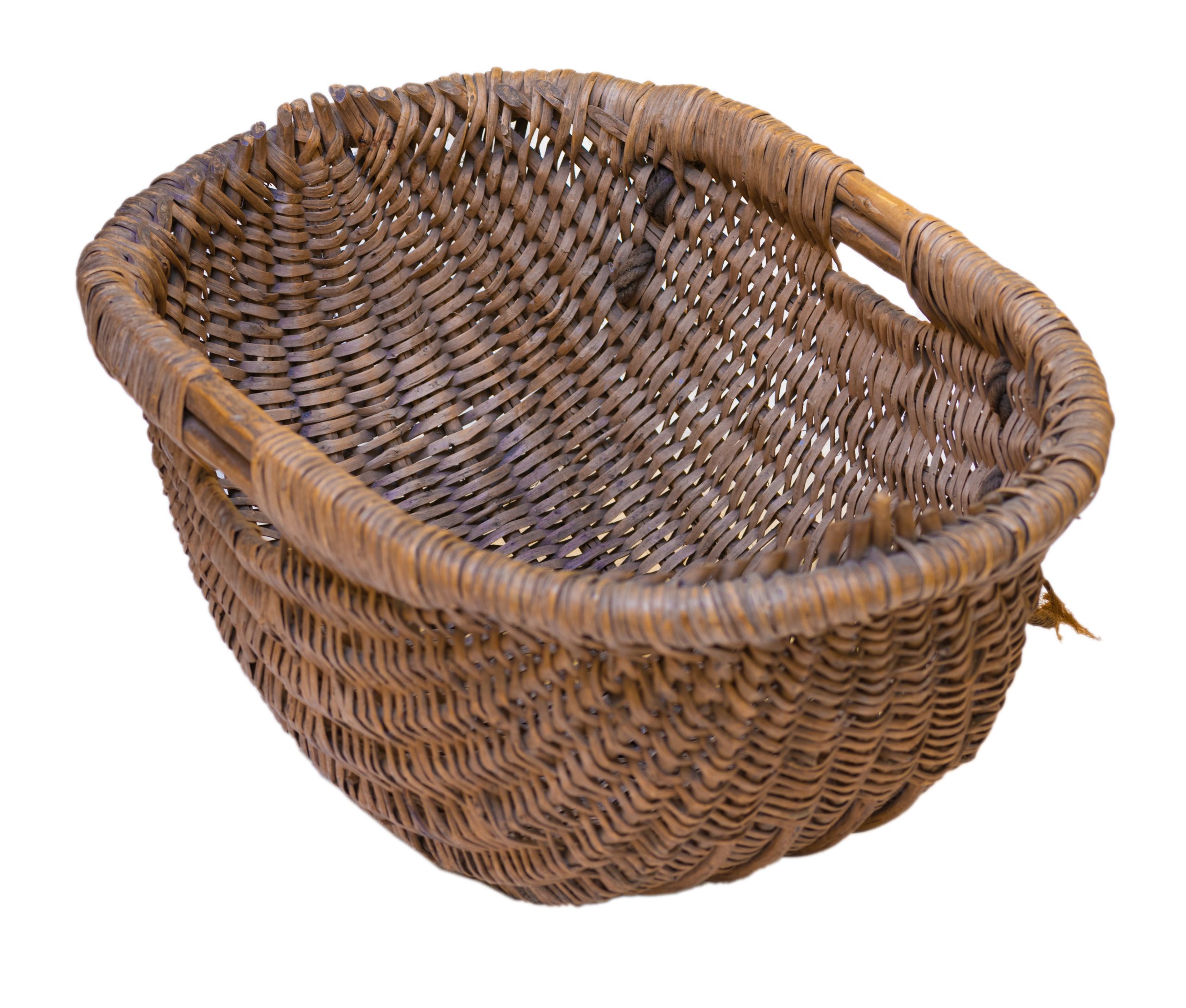
Creel basket
Creel baskets like these were used in Cromarty for carrying fish and other items like firewood.
They were mostly woven by women, who played important roles in fishing life. As well as running the household, women mended nets, baited lines for fishing, prepared and sold the fish, and even carried the men to their boats to make sure they could go to sea in dry clothing.
Trade
Cromarty’s port allowed the town to trade with the world. In 1593, it was recorded as ‘one of the best portes in this ysland’. As well as fish, Cromarty manufactured hemp which was spun in Cromarty’s hemp works. It was then made into sacks that were used to bag cotton, tobacco, and coffee. These goods were farmed by enslaved people in the Caribbean.

Rope jack
Cromarty had one of the earliest factories in Scotland. It was set up by George Ross, the Laird, in the 1772. The factory manufactured hemp sacking with the raw hemp imported directly from ports around the Baltic Sea. A rope works was set up in the factory in 1805 to spin the hemp into lengths of rope. This is one of the original hand spinners from the Cromarty rope walk.
The factory closed in 1853 as it was unable to compete with newer mechanised processes. It was left to ruin until it was converted into housing in 1989, which you can see on Marine Terrace.
Energy
Our modern need for energy has changed Cromarty’s relationship with the sea and with our firth. Oil rigs began to appear in the Cromarty Firth following the oil boom of the 1950s. More recently, the firth has supported green energy production. Seeing both of these industries side by side is a stark contrast.
What’s Happening in Our Firth?
Our relationship with the Cromarty Firth has changed over time. The landscape around the firth, and the water itself, have also changed. This environment reflects how our use of energy has developed over time. Historically, we had a harmonious relationship with the sea, taking and using only what we needed. The firth was rich in fish like herring and salmon, a source of energy which sustained the people of Cromarty. However, overfishing and cheaper imports meant our use of the firth had to adapt. Rather than using the firth for energy through food, we transitioned to use the firth to support our insatiable need for energy through power.
Read more
Cromarty has become synonymous with oil rigs. The naturally deep firth has acted as their waiting room since the 1970s, as they come and go from the North Sea, drilling for oil and natural gas. When they reach the end of their lifespan, the rigs are usually sent abroad to be dismantled and recycled. This means that the rigs in the firth are either being repaired or playing the long game: lower oil prices see more rigs waiting in the firth, and when oil prices rise, they are sent back to work.
The Port of Nigg is a hub of energy production. It was built in 1972 to service the oil and gas industry. However, its North Sea Oil Terminal was recently decommissioned, and the port is adapting. It now supports different projects in the marine, subsea, topside, nuclear, and renewable sectors. These projects include both fossil fuel and green energy use. As well as energy production, the port also helps to move energy around. Construction is underway for a new, 205-mile subsea cable. This will connect offshore energy produced in Shetland with mainland Scotland and the National Grid.
The huge buildings at the Port of Nigg are home to the infrastructure needed to build the components for offshore wind turbines. The large-scale production aims to create a new offshore wind farm, which will generate enough renewable energy to power the equivalent of more than 1.3 million homes.
A Changing Landscape
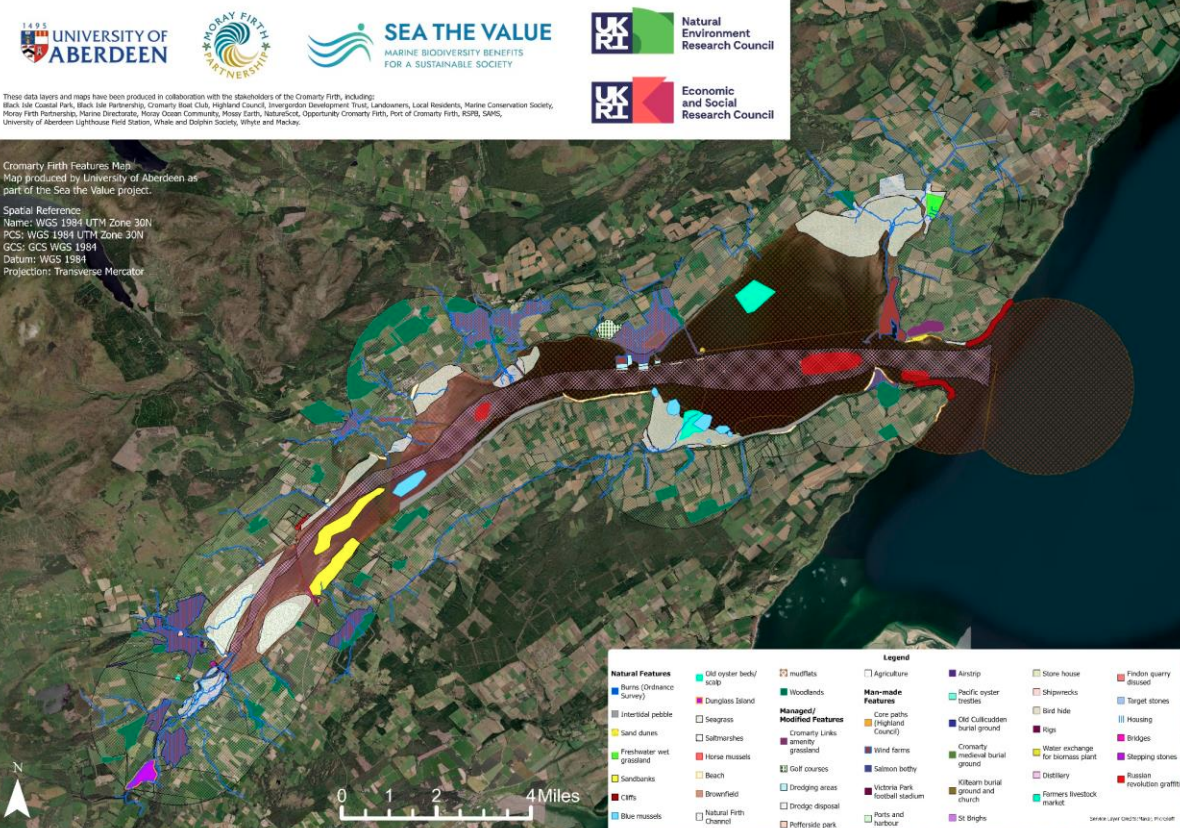
Our need for energy, both as a source of food and as a source of power, has visibly impacted the landscape around the firth. This map was created by ‘Sea the Value’, a collaboration between the University of Aberdeen, Moray Firth Coastal Partnership, and UK Research and Innovation.
This map was created by asking local people to point out different features of the landscape around the firth. These features are either natural, managed, or man-made. Some of these features include seagrasses, sandbanks, mudflats, woodland, farms, and housing. The map also highlights the habitats of different marine species. This helps us to understand how biodiversity in the firth is changing.
The communities who live around the Cromarty Firth are impacted by the changing landscape. We are exposed to the effects of rising sea levels, invasive species, poor water quality, and noise and light pollution. Think about the following questions…
How do you feel about the oil rigs in the firth?
Do you think Cromarty, and communities around the firth, should benefit from lower energy prices?
What do you think are the pros and cons of offshore wind power?
How can we help protect our natural environment?
Marine Life
Throughout history people have made their lives around the Cromarty Firth whether through fishing, farming or renewable energy. Whilst the area supports internationally important populations of birds and cetaceans, much has been lost due to human pressures. Native oysters (Ostrea edulis) were once fished in the firth but are now believed to be extinct, with the last recorded landing of oysters in the Cromarty District being in 1884 numbering 26,000 individuals. The reason for their local extinction is thought to be overfishing. The non-native Pacific oyster (Magallana gigas) was intertidally farmed using trestles in the Cromarty Firth near Shoremill in the recent past, but has since ceased.
Read more
The Cromarty Firth was a vital location for herring fishing, with the Cromarty fishing district becoming the 8th largest herring station in Britain by the mid-1820s. In 1897 there were 66 fishing boats in Cromarty, but by the 1930s, there were none after overfishing. The Cromarty Firth has a long history as a deep, natural harbour, used as a naval base and for the construction and repair of North Sea oil rigs since the 1970s.
Accounts from local fishers suggest that the local blue mussel (Mytilus edulis) populations are also struggling. Declines in natural resources has eroded the bond between the firth and the communities along its shores. Rebuilding resilient and biodiverse marine habitats also presents an opportunity to mend connections between local people, their livelihoods and coastline. Local restoration efforts and community engagement that Moray Ocean Community and Mossy Earth are carrying out seek to address these issues.
Listening to our Community
We worked with Cromarty Youth Cafe to record local people’s thoughts about the changes that are happening in our firth. The Youth Cafe came up with interview questions, and posed them to each other and to members of the local community.
Collecting oral histories helps us to capture the thoughts, emotions, and opinions of people in a specific time and place. These are some of the questions the Youth Cafe posed to our community:
What does the Cromarty Firth mean to you?
Why do you think the Cromarty Firth is important?
How does the Cromarty Firth affect your life in Cromarty?
Activities on the Firth
Marine science
Wild swimming & gardening
Beach clean-ups
Oil rigs
Getting close to nature
Be the Change
Moray Ocean Community (MOC) is a volunteer group passionate about exploring, protecting and celebrating the amazing Moray Firth coastline. Here are some of the MOC activities for fostering positive coastal community action that everyone can get involved in:
- Restoration Days: Volunteering with local restoration projects, like Mossy Earth, can be great opportunities to learn new skills .
- Citizen Science Initiatives: Help collect important information on different habitats and species like seaweed, whales and dolphins or invasive species like slipper limpets
- Beach Cleanups: help clean up the coastline with a beach clean – these are always good fun and family friendly
Outreach: Help take the ocean into the community through school visits and community talks or join an online MOCTale webinar.
Read more
Mossy Earth are leading a local restoration initiative Wilder Firths (Linneachan nas Fhiadhaiche) who’s vision is for the firths surrounding the Black Isle to be home to a resilient mosaic of biogenic (living) habitats that support diverse and thriving ecosystems. Central to achieving and sustaining this vision are local communities that are connected to and invested in their coastal environment.
Wilder Firths is run by a locally based team and focuses on native oysters, seagrass and other biogenic habitats. There are a range of ways for local communities to get involved like seagrass surveys, seed collection and planting. Wilder Firths work in collaboration with Moray Ocean Community. Scan the QR code to watch a short film about their work in the Cromarty firth.
We’re in this together

‘Changing Tides: Cromarty’s Firth’ is part of the Natural History Museum’s Community of Practice for ‘Fixing our Broken Planet’.
The Natural History Museum has provided grants for research and exhibitions addressing the planetary emergency. Partners will open conversations on topics such as biodiversity decline, climate change, and pollution.
12 regional museums, heritage and cultural partners across the UK are running events and activity focused on creating advocates for the planet. This follows the opening of a free permanent gallery, ‘Fixing Our Broken Planet’, at NHM in South Kensington in April 2025.


Thanks for visiting! Discover more amazing exhibitions…
