
celebrating
150 years
‘A Window to the Past’ is a celebration of Cromarty School through the ages, from its founding in 1875 through to today.
Schooling life has changed a lot over the years. This exhibition looks at the school’s history in different periods: before WWI (1875-1914), the wartime period (1914-1945), and post-war (1945-1990). Objects from our collection and on loan from the Highland Museum of Childhood also help us tell the story of schooling from 1990 to the present day.
Thank you to our volunteer researchers Fran Sadler and Heather Lintie for their visits to the Highland Archive to look through Cromarty School’s Log Books, and for kindly allowing us to display their research.
1875-1914
The 1872 Education Act of Scotland was created by the Board of Education, with locally elected school boards instead of churches in charge of reading, writing, and arithmetic. It became obligatory for children aged 5–13 to attend school. There was an exemption for children aged over 10 who could show that they had achieved an adequate standard.
The Cromarty School building was completed in 1876. Children marched through town preceded by Artillery Volunteers, and the School was decorated with flags supplied by the coastguard.
Summary of Inspector’s report 21st – 22nd May 1877: “Infant Room desks for writing should be supplied. A very few read well but reading as a whole is very backward, especially for town children. Very few of the children have slates and consequently writing behind.”

In 1877, attendance at Cromarty School was just 64%. Attendance fluctuated with the local demand of farm work, in particular ‘potato lifting’.
Cromarty School Band – c.1974 (courtesy of Cromarty Archive)
health
From 1911, Cromarty School received regular visits from the local dentist and Medical Officer.
Outbreaks of measles, mumps, whooping cough, chicken pox, scarlet fever and pneumonia in January of 1911 resulted in the closure of the school for infectious diseases, and reduced attendance for the non-infectious. School summer holidays were extended in 1913 due to whooping cough.
In February of 1924, the school closed for one week due to an influenza outbreak. For a week in May 1932, attendance was lower owing to some children being away through having teeth extracted by the visiting dentist.


Harsh weather conditions also made absence from illness more likely: school holidays were given for bad weather (storms, snow, hard frost) and were often dismissed after the morning lesson for the same reasons. One half day was given for skating on the frozen ponds on 5th February 1912, after all the pipes in the school froze.
Primary 2 – 1961 (courtesy of Cromarty Archive)
1914 – 1945
Both WWI and WWII had a significant impact on life at school. Resources were scant: in January of 1918, there was no coal to be found to heat the classrooms, so school was dismissed for a week.
Oct 19th 1924 was declared a half-holiday to mark the unveiling of the cross erected by the War Graves Commission in the Gaelic Churchyard in memory of the sailors and soldiers who died in Cromarty during the Great War.
The school was closed from 4th – 8th September 1939 by order of the Education Authority, owing to the outbreak of war between Britain and Germany.
The school closed for two extra days in May 1945 as the 8th and 9th were proclaimed national holidays on announcement of victory. It closed again on 17th and 18th August for V.J. Day.
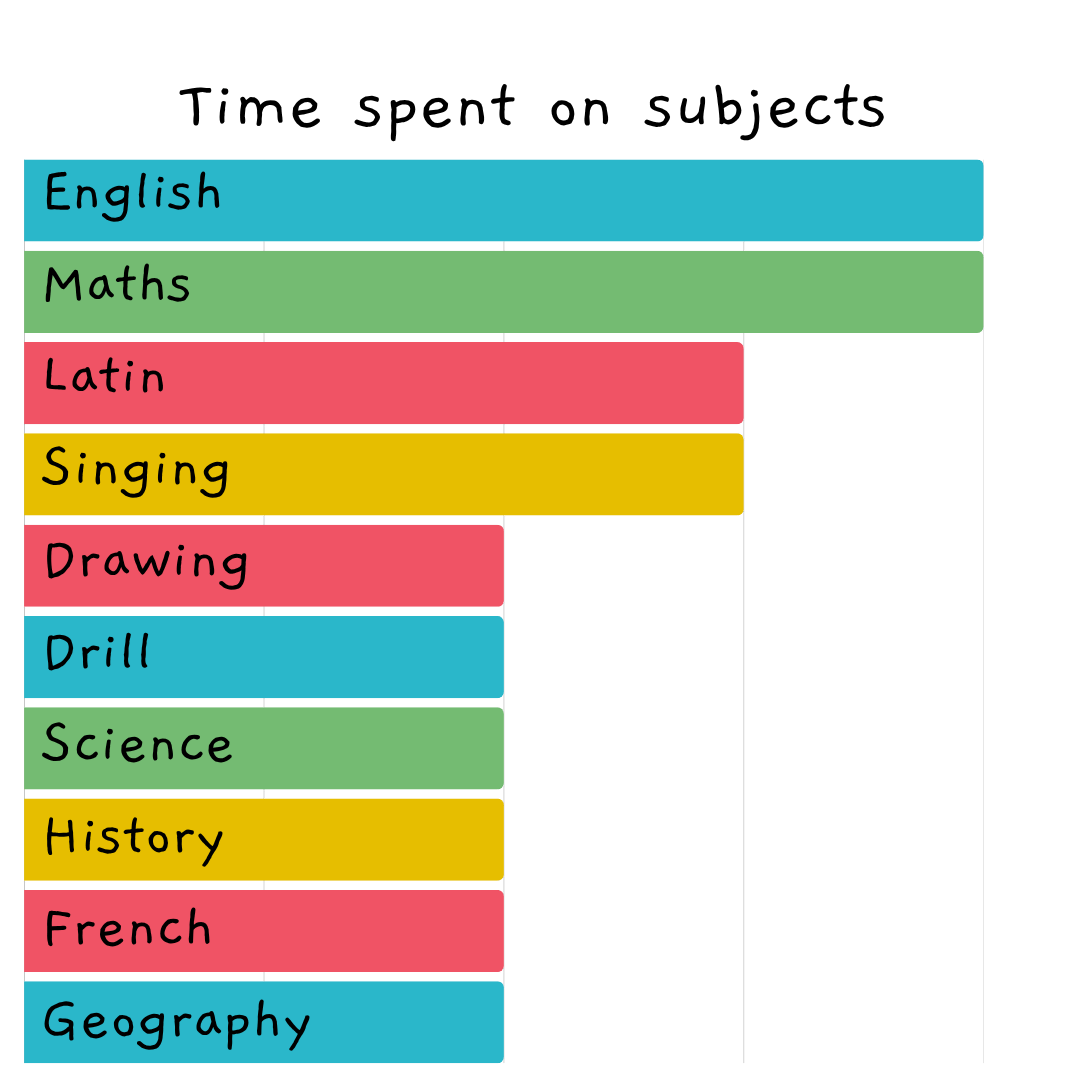
During this period, 10 main subjects were studied. Needlework, cookery, paper folding, and cardboard modelling were later added. After the outbreak of WWI, all needlework classes were devoted to knitting hats and scarves for troops.
1977 (courtesy of Cromarty Archive)
school meals
By the 1950s, the school kitchen had been upgraded to all-electric. It was recommended in 1954 that children should be provided with a meat course for lunch, or a meatless dish rich in protein, like soup. Between 40 and 100 meals were served per day from the school canteen.
A typical meal:
Brown stew, potatoes, cabbage, sago pudding, and jelly. Second helpings available if desired.
In 1950 alone, over 1,000 gallons of milk were drunk by pupils (that’s nearly 4,000 litres!) and 20,937 meals were served in the school canteen.
In 1968, the Secretary of State for Education and Science withdrew free milk from secondary schools for children over eleven. His successor, Margaret Thatcher, withdrew free school milk from children over seven in 1971.

Cromarty Primary leavers – c.1921-22 (courtesy of Cromarty Archive)
1945-1990
In April 1962, plans commenced for building a new school house on the Links, however these were delayed until Spring 1965. A meeting took place in March 1965 that delayed a the build for another 8 years due to objections. In 1966, all plans were abandoned and the school was downgraded to Primary only. 30 of Cromarty’s Secondary pupils were transferred to Fortrose Academy.
Pupils occasionally received visits from different industry professionals delivering careers talks. In 1956, the Secondary girls received a talk on nursing, and in 1963, an Army recruiting officer visited the boys.
In June 1963, the school received a visit from RoSPA (the Royal Society of the Prevention of Accidents) showing road safety films in line with 13 pupils taking their cycling proficiency tests.

Cycling Proficiency Test, Cromarty School, 1963 (courtesy of Cromarty Archive)
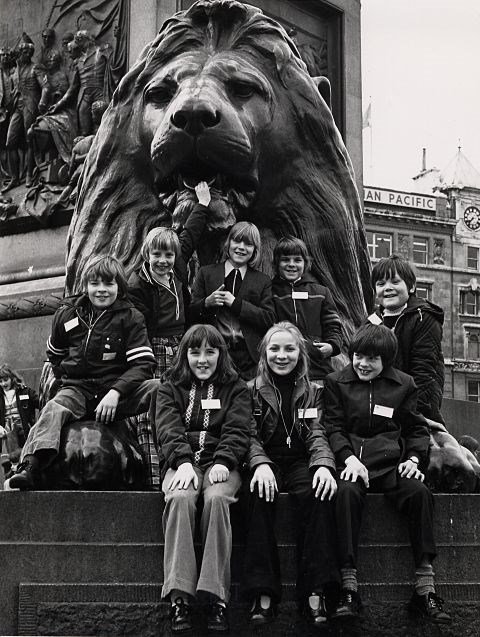
School Trip to London – Trafalgar Square, April 1975 (courtesy of Cromarty Archive)
Primary 3-4, Christmas, 1973 (courtesy of Cromarty Archive)

Thank you for visiting! Discover more great exhibitions…
