

On 28 September 1843, there were riots at Resolis Parish Church in protest against the new Church of Scotland minister being sworn in. Margaret Cameron was arrested, taken to Cromarty Gaol, and then later was broken out by a crowd of supporters.
The riot and subsequent jailbreak was reported widely across the UK, with features even reaching newspapers in Boston. Newspaper coverage overwhelmingly condemned the riots, and reported the actions of locals in patronising terms, thereby demonstrating the global attitudes towards Scottish highland people and culture at the time. Despite this condescending approach, the global coverage shows the impact of this small demonstration in Resolis and the power of protest!
This exhibition has been researched and curated by Young Curators Amy Harrison and Mairi Taylor.
“Heinous sinfulness of resisting the civil law”
Morning Herald (London), 5 October 1843, p. 2
28th SEPT
Parish church of Resolis
2 PM
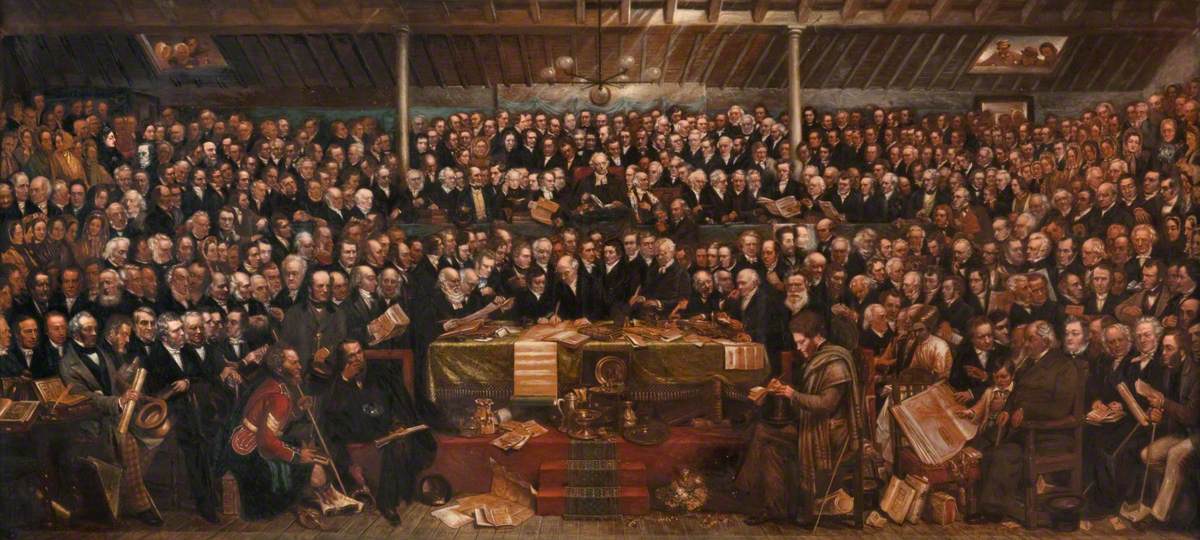
Image: The First General Assembly of the Free Church of Scotland (after David Octavius Hill) by Amelia Robertson Hill (1820–1904). Credit: The Hunterian, University of Glasgow
The Riots in the Media
Ross-shire – Aberdeen – Manchester – London – Dublin – Boston
Ross-Shire
Many newspapers had articles copied from the Ross Shire Advertiser, cited by the Nonconformist (London) as a ‘state-church paper’. This was a cheaper way of wide-spread reporting. ‘More Riots in Ross-Shire’, Nonconformist, London, 4 October 1843
Aberdeen
‘Rioting at Resolis – Deforcement of the Presbytery of Chanonry and the Magistracy – The Riot Act Read’ – Aberdeen Press and Journal (Aberdeen), 4 October 1843, p. 3.
‘The Lord Lieutenant, in gallantly attempting to seize one of the stoutest and most active of the ringleaders of the mob, received a blow on the arm’; The Lord Lieutenant was in charge of raising local militias and keeping law and order, so would have had a high profile in the area. He has been painted here in a heroic light, simultaneously downplaying the sense of injustice and agency in local people. The injuries of the Lord Lieutenant are mentioned, alongside that of the Sheriff and Procurator Fiscal, however no injuries towards the protestors are reported.
A ‘bold virago… was apprehended in the act of cheering on the others, and immediately sent off to Cromarty’. ‘Virago’ implies that Margaret Cameron was strong, confident and brave. Coming from the Latin ‘virago’ meaning ‘warrior woman’, it was actually a derogatory term at the time. It implied that Margaret was overstepping her role as a woman, acting in a domineering fashion not befitting her gender.
Dublin
‘Sanguinary Non-Intrusion Riot at Resolis, Near Cromarty’, Freeman’s Journal (Dublin), 5 October 1843, p. 4
‘Sanguinary Non-intrusion Riot’
This headline gives a useful insight into how the protest was understood and portrayed: sanguinary means bloody and suggests the protest was very violent despite the fact there was few injuries non-intrusion refers to the parishioners request that the people should be free to chose their church minister and have the right to reject a minister ‘intruded’ upon them by the local landowning laird. ‘One woman, more bold than the rest, advanced so near that Mr. Cameron, the Procurator Fiscal. seized her; she resisted, however, so vigorously that it was not until they had both fallen and rolled upon the earth that she was secured, placed in a gig, and driven off to Cromarty gaol’. Again, this melodramatic reporting projects the authority’s fear of petty violent protests as a threat to public order; describing a physical struggle between a local protester and legal authority.
NB: there were just 3 police officers in east Ross-shire during this period, so authorities were keen to silence any protests as quickly as possible.
‘The sheriff’s officer who had conveyed the female to prison was waylaid, seriously maltreated, and his vehicle dashed to pieces’. Black Islers are again protrayed as violent people, This reflects longstanding attitudes towards the ‘savagery’ of Highlanders, and undermines any sense of legitimate political expression. As an illiterate, Gaelic-speaking woman in this period, rioting would be one of the only ways for Margaret Cameron to effectively protest the injustice that her community was experiencing.
Manchester
‘NON-INTRUSION RIOT AT RESOLIS, NEAR CROMARTY’ The Manchester Guardian (1828-1900); Manchester (UK). 07 Oct 1843: 3.
‘The spirit of riotous opposition by members of the Free Church to the ministers in the vacant parishes, which exhibited itself at Roskeen last week… was exceeded in violence at Resolis’. The riots at Resolis were not an isolated incident, however this reporting implies that the repeated protest against Church of Scotland ministers served to panic authorities. It fuelled their fear of losing both legal and religious authority over the highland population. ‘…greeting them with a volley of stones…order was given to fire upon the rioters and charge with their cutlasses and sticks’.
These quotes demonstrate that the protest was not treated as legitimate political expression, but instead a threat to public order which must be silenced with force. This shows the complete breakdown in communications between authority and the local community.
London
‘SCOTLAND’ – The Spectator, London Vol. 16 (798), 14 October 1843
‘The religous riots in scotland have been quelled’
Reporting on the issue in London demonstrates the significant impact of the Resolis riots. Again, the paper presents the rioters as lawless and dangerous, celebrates the authorities successful suppression by force and frames ongoing unrest as a threat to be controlled instead of a social issue to address.
Boston
‘The Scotch church disturbances’ – Christian Register, Vol. 22(45), 11th November 1943
“The disturbances which have lately attached no very enviable notoriety to this district have luckily ceased, and the authorities are occupied with the examinations, or taking further steps for the apprehension of the rioters. Several persons are now in the jails of Tain, Dingwall, and Cromarty, for trial: but the principal parties concerned in the Resolis rioting, and the breaking of the prison at Cromarty, have absconded, but cannot long elude the officers of justice, to whom they are all well known, by description or otherwise”
Reporting of the riots in Boston demonstrates the significant impact of this small protest in Resolis. The condescending tone here suggests shame or disapproval towards the protesters, rather than sympathy. This reporting separates respectable society from the rioters, treating the disturbances as an unnecessary stain on the local area, rather than a justified and legitimate
protest against injustice.
read the riot act
right to protest
The Riot Act of 1715 allowed magistrates to order an unlawful protest to disperse within an hour or face severe punishment. In an attempt to control the protest, the riot act was read by the sheriff at Resolis to force the crowd to disperse.
The phrase “read the riot act” has since become a shorthand for a stern warning, but at Resolis this represented a clash between the written law of state authority and moral force of local community resistance.
Media framing of the event, which was strongly influenced by political and landowning interests, depicts protesters as an unruly and ignorant mob. However, a closer look reveals a last resort attempt to assert human dignity.
Today, media still wields the power to define public perception of protest, determining whether resistance is seen as legitimate or lawless.
How we represent riots and other acts of protest determines whether they are remembered as criminal disturbances or moments of courage and defiance which push society towards fairness and reform.

Image: 1714 Riot Act. Credit: Parliamentary Archives, HL/PO/PU/1/1714/1G1s2n7
IMPACT OF PROEST
The riots took place during a period of major social and religious tension in Scotland and their immediate impact was both locally significant (the Reverend John MacKenzie was never inducted to the Parish of Resolis) and symbolic. The press depicted the protesters as dangerous rioters rather than people resisting injustice, reinforcing the idea that rural communities needed to be controlled, not heard.
History judges societies not by how they prevent protest, but how they listen to it
In Margaret’s words
Despite Margaret Cameron’s involvement in the riot, arrest and trial, she couldn’t write in English and her examination in the trial was conducted in Gaelic. It is unlikely that she ever read newspapers alluding to her involvement in the Resolis Riots. No local protesters, including Cameron, are named in the above publications. This may be for a number of reasons; perhaps the fear of Highland protest made them refrain from naming people that could gain local political influence. Perhaps, they simply didn’t know the local population. The lack of identity for protesters further amplifies the patronising tone in reporting of the riots.
MARGARET’S STATEMENT
“Compeared Margaret Cameron residing at Ferrytown in the parish of Resolis, an unmarried woman, aged thirty years or thereby [she was actually 47] who being judicially examined and interrogated, Declares that she was at the parish Church of Resolis yesterday being the twenty eighth day of September current and that she came there about two o’clock in the afternoon. Declares that she saw a number of people round about the Church and saw some stones thrown and heard “shooting”. Declares that she also saw a number of Gentlemen about the Church none of whom she knew with the exception of Messrs. James Duncan Cromarty Mains and William Watson merchant in Cromarty. Declares that she does not know any of the other people who were there. Declares that she saw William Fraser shoemaker and Fisherman at Ferrytown going through a field near to the Church; that this was when she heard the shooting.
Declares that she that did not know that Mr Mackenzie’s statement was to take place in Resolis that day but on hearing the Church Bell toll she went there to see what was going on. Declares that she lifted one stone but did not throw any. That soon after lifting the stone she was seized hold of by some person whom she does not know and was taken into Cromarty where she was put into Jail. Declares that she knows a family of the name of Urquhart at Cullicudden. That she thinks there are three sons and that one of them was yesterday at the Church of Resolis. That he was walking a little above the Church when she saw him. That she did not see Urquhart throw any stones. That she thinks she saw Eppy Aird wife of Donald Watson shoemaker Balblair in the crowd about the Church but she is not sure. That she heard Mr. Watson call Eppy Aird’s name. All which she declares to be truth and declares that she cannot write.”
Written, researched and curated by Amy Harrison and Mairi Taylor as part of the Young Curators programme at Cromarty Museum
Thanks for visiting! Discover more amazing exhibitions…
